Part 6 –> ERP Implementation Framework:
⚠️ERP Design Technique: Where Projects Are Won… or Quietly Destroyed:
ERP is not configured.
It is designed.
And design is not about system.
👉It is about how your business will run tomorrow.
What is the Design Phase (Real Meaning)
The design phase is NOT:
– Drawing flow diagrams
– Copying current processes
– Listing screens & fields
The design phase is:
– Translating business strategy into executable ERP processes
It answers:
– How will we operate tomorrow?
– What will we stop doing?
– What will the system control?
– What decisions will be automated?
Why Design Phase is So Critical
Once design is locked:
– 80% of ERP outcome is already decided
If design is weak:
– Configuration becomes messy
– Customizations increase
– Costs go up
– Timelines slip
– Business loses trust
If design is strong:
– ERP stays standard
– Deployment is faster
– Adoption is smoother
– KPIs improve
What MUST Be Included in Design
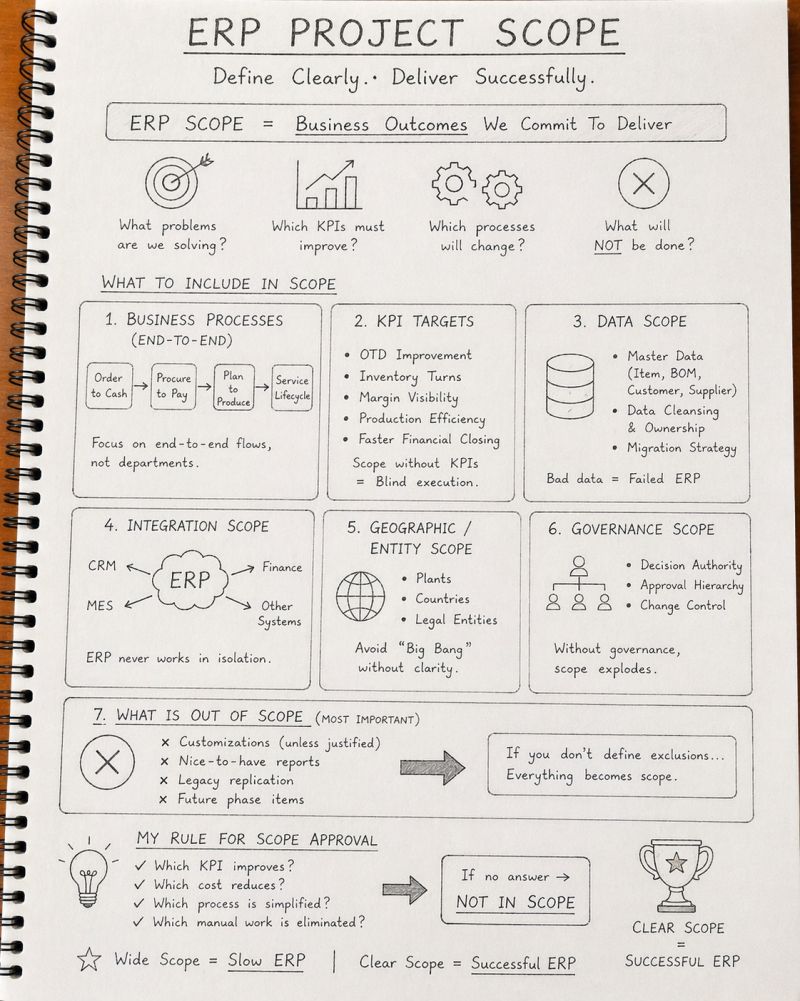
– End-to-end business processes (O2C, P2P, Plan → Produce)
– KPI alignment (OTD, Inventory, Margin, Cycle Time)
– Clear roles & ownership
– Decision logic (who decides what & when)
– Exception handling
– Data ownership & governance
– Integration touchpoints
– Business rules (approval, control, limits)
Design = Business + KPI + Control + Ownership
What You MUST EXCLUDE (Biggest Mistakes)
– “Nice to have” features
– User personal preferences
– Copy-paste of legacy system
– Early customization decisions
– Reports without business purpose
– Over-detailed technical design
If you include everything… you will deliver nothing.
The Brutal Truth
Most ERP designs fail because:
– Business is not involved
– Consultants don’t challenge
– Leadership wants everything
– No KPI ownership
So design becomes:
– Documentation exercise… not transformation
My Design Principle
Before approving any design, I ask:
Which KPI improves?
Which cost reduces?
Which manual step is eliminated?
Who owns this process?
If there’s no clear answer…
👉It doesn’t go into design.
#ERP#ERPDesign#DigitalTransformation#InforLN#CIO#ERPStrategy#BusinessKPIs#ERPImplementation#Leadership#ProcessTransformation#CloudERP
Leave a Reply