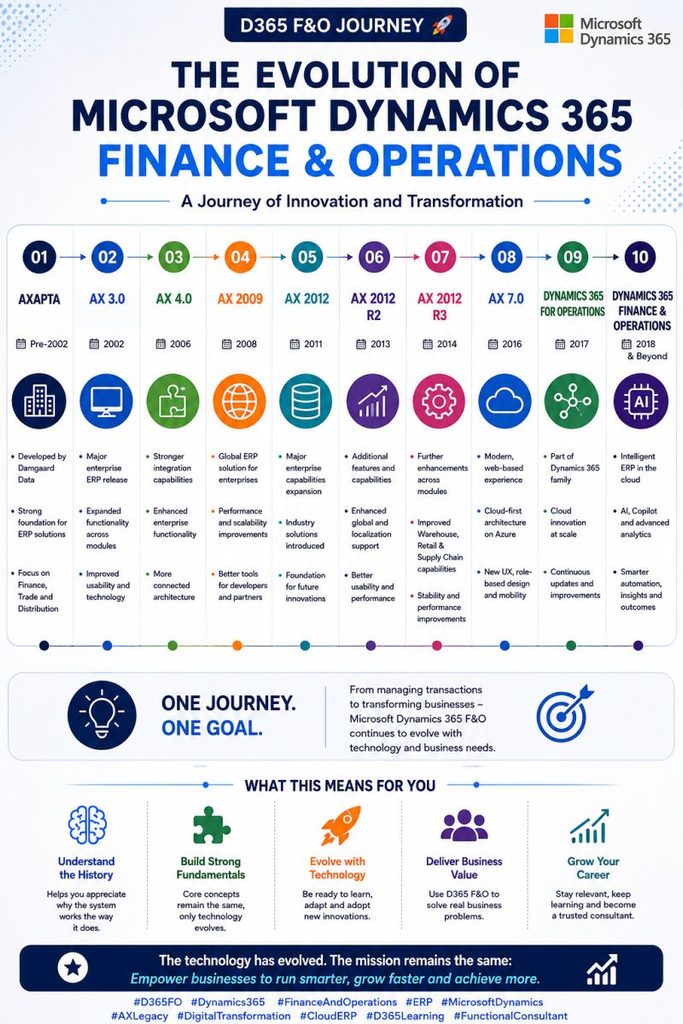
— a journey of innovation and transformation.
If you’re learning Dynamics 365 Finance & Operations, you may have heard of AX 3.0, AX 4.0, AX 2009, AX 2012, AX 2012 R2/R3, AX 7.0 and D365 F&O.
But how are they connected? 🤔
🕰️ Axapta — The foundation of the Dynamics AX journey
🔵 AX 3.0 — 2002
Strong ERP capabilities across Finance, Trade, Inventory, Production and Projects.
🟢 AX 4.0 — 2006
Enhanced enterprise functionality, integration and architecture.
🟠 AX 2009 — 2008
Expanded global ERP capabilities and enterprise processes
🔵 AX 2012 — 2011
A major milestone with broader Finance, Supply Chain, Manufacturing, Retail, Warehouse and Project capabilities.
🟣 AX 2012 R2 & R3
Further enhancements across global functionality, Supply Chain, Retail and Warehouse Management.
☁️ AX 7.0 — 2016
A major shift toward a modern, browser-based and cloud-first ERP experience.
🌐 Dynamics 365 for Operations
The product entered the Dynamics 365 family and embraced Microsoft’s cloud strategy.
💙 Dynamics 365 Finance & Operations
The evolution continued into the modern cloud ERP platform we know as D365 F&O.
🤖 D365 F&O + AI
Today, the journey continues with AI, Copilot, automation, analytics and intelligent business processes.
📈 The Journey:
Axapta → AX 3.0 → AX 4.0 → AX 2009 → AX 2012 → R2 → R3 → AX 7.0 → D365 for Operations → D365 F&O → AI
🎯 Why does this history matter?
Because D365 F&O didn’t appear overnight.
Understanding its evolution helps consultants better understand legacy systems, migrations, architecture and today’s business processes.
💬 My D365 F&O journey started with AX 3.0
What about you? 👇
Which Dynamics AX/D365 version did you start your journey with?
Or, if you’re just starting out? 🚀
Share your journey in the comments — let’s see how many different generations of Dynamics consultants are here! 😊
The technology has evolved. The mission remains the same:
Empower businesses to run smarter, grow faster and achieve more. 🚀